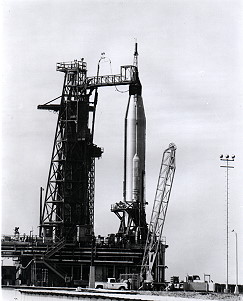
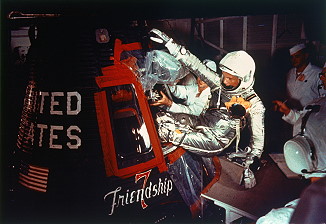
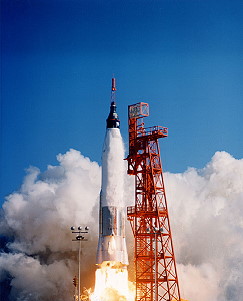
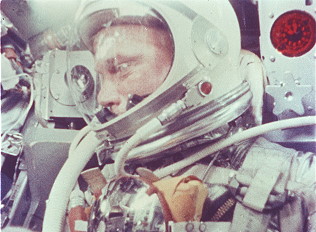
Launch from Cape Canaveral and landing
northwest of Puerto Rico in the vicinity of Grand Turk Island (Atlantic
Ocean).
After two ballistic flights by Alan
Shepard and Gus
Grissom,
John
Glenn
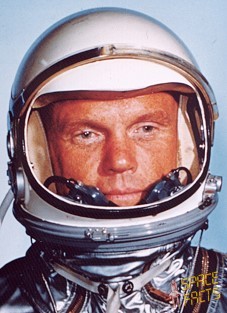
became the first American in orbit. Three problems occurred during the
flight. First, a yaw thruster was causing attitude control problems, forcing
the astronaut to abandon the automatic control system for the manual electrical
fly-by-wire system. Second, a faulty switch in the heat shield circuit
indicated that the clamp holding the shield had been prematurely released - a
signal later found to be false. During reentry, however, the retropack was not
jettisoned but retained as a safety measure to hold the heat shield in place in
the event it had loosened. If the signal had been correct, John
Glenn
would have not survived this flight. Moreover, the temperature in John
Glenn's spacesuit was too warm. During the landing the
astronaut could not manually control the ship, while more and more fuel was
being lost. John
Glenn
decided to deploy the drogue chute manually to regain attitude stability. Just
before he reached the switch, the drogue chute opened automatically at 8,5 km
(not as planned 6,5 km), but in any-case the spacecraft regained stability.
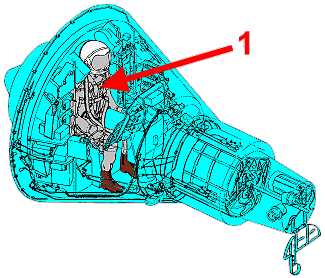
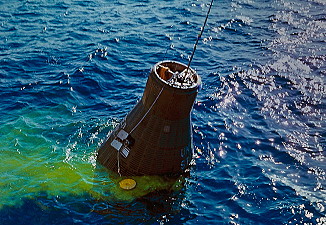
Friendship 7 splashed down in the Atlantic about 40 miles (60 km) away
from the planned landing zone. Retrofire calculations had not taken into
account the spacecraft weight loss due to the use of onboard consumables. The
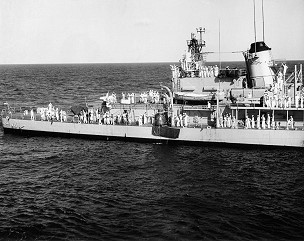
spacecraft was recovered by the destroyer
USS Noa.
During pickup John
Glenn
remained in the spacecraft.