Human Orbital Spaceflights

International Flight No. 354Shenzhou-20People's Republic of China |
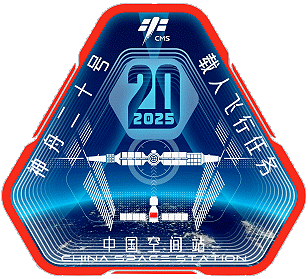 |
Launch, orbit and landing data
walkout photo |
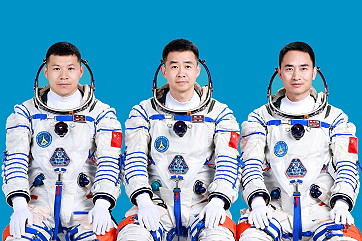
|
||||||||||||||||||||||||||||||||||||||||||||||||||||||||||||
Crew
| No. | Surname | Given names | Position | Flight No. | Duration | |
| 1 |  |
Chen | Dong | Commander (Zhĭlìng zhăng) | 3 | 203d 23h 23m 00s |
| 2 | |
Chen | Zhongrui | Astronaut 2 (Hángtiān yuán èr) | 1 | 203d 23h 23m 00s |
| 3 | |
Wang | Jie | Astronaut 3 (Hángtiān yuán sān) | 1 | 203d 23h 23m 00s |
Crew seating arrangement
|
 |
|
||||||||||||||||
Hardware
| Launch vehicle: | Long March 2F/G (Chang Zheng CZ-2F/G / Y20) |
| Spacecraft: | Shenzhou-20 |
Flight
|
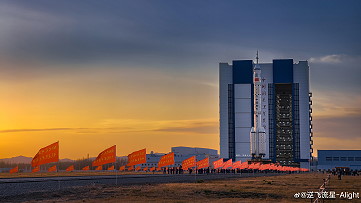
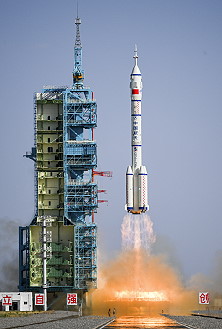
Launch from Jiuquan Satellite Launching
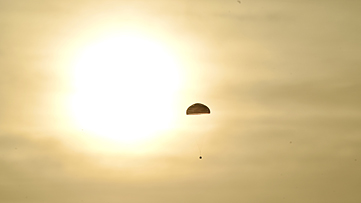
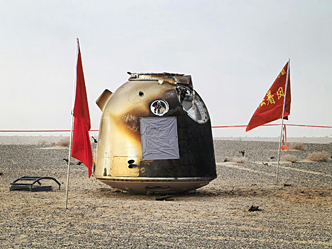
Center. On November 05, 2025 CMSA announced the return of Shenzhou-20 postponed due to a suspected impact on the spacecraft by space debris. Shenzhou-20 docked on 24.04.2025 at 15:49 UTC to the space station Tiangong and the astronauts became members of TG-8. Shenzhou 20 has returned with some cargo of opportunity from the space station, including EVA spacesuit "b" (blue strips marking) being retired after reaching its 20 times usage limit. The Tiangong space station (English: Heavenly Palace) can accommodate three astronauts under normal circumstances and up to six during a crew change. The station will be T-shaped with the core module in the middle and a laboratory capsule on each side. Each of the modules will weigh more than 20 tons, with a total mass of the station of about 66 tons. The space station, which is expected to be completed in 2022, is expected to operate for more than 10 years in low-earth orbit at an altitude of 340 km to 450 km. The station's core module, named Tianhe (English: Heavenly Harmony), has a total length of 16.6 meters, a maximum diameter of 4.2 meters and a launch mass of 22.5 tons and is currently the largest spacecraft developed by China. The Tianhe core module will be the management and control center and the main living room of the crew, and will support some science and technology experiments. The living space in the core module is approx. 50 cubic meters. In combination with the two laboratory capsules, the total living space could be up to 110 cubic meters, according to the China Academy of Space Technology (CAST). The core module has two berth connections connected to the two laboratory capsules and three docking connections for the spaceship, cargo and other crew vehicles. It also has an exit for astronauts to conduct extravehicular activities. The first laboratory capsule, named Wentian (English: Sky Inquiry), is mainly used for scientific and technological experiments, as well as for work and living spaces and emergency shelters. This capsule is equipped with a special airlock chamber to support extravehicular activities and a small mechanical arm for the automatic installation and operation of instruments on the shell of the space station. The second laboratory capsule, named Mengtian (English: Heavenly Dream), has similar functions to the first laboratory capsule. It is equipped with a special airlock chamber that supports the entry and exit of cargo and instruments with the help of astronauts and mechanical arms. The Long March-7 rocket and the Tianzhou (English: Sky Ship) cargo spaceship are used to transport materials, propellants and instruments for the station. The Long March-5B rocket will launch the core module and laboratory capsules, as well as a capsule with a 2-meter caliber optical telescope, which will fly in the same orbit as the space station. The telescope capsule, named Xuntian (English: Sky Survey), is designed to provide observational data for astronomical and physical studies to enable scientists to better understand the universe. It can observe over 40 percent of the sky during its expected 10 years of operation. The capsule can dock with the space station for maintenance and refueling. The astronauts became Tiangong Crew-8 and later Crew-9. |
Photos
 |
 |
|
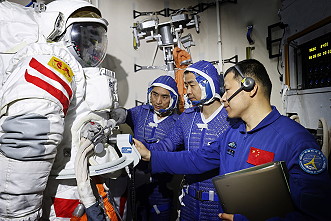
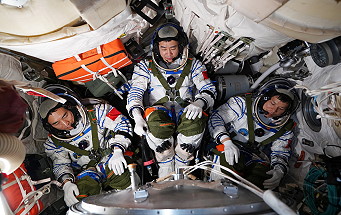
source of all photos is CNSA |
|
 |
 |
 |
 |
 |
 |
 |
 |
| © |  |
Last update on February 01, 2026.  |
 |