Bemannte orbitale Raumflüge

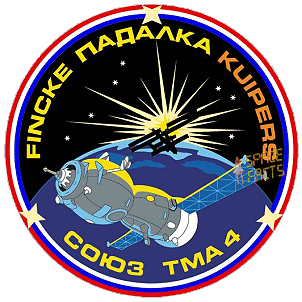
Internationale Flug-Nr. 238Sojus TMA-4AltairRussland |
 |

|
Start-, Bahn- und Landedaten
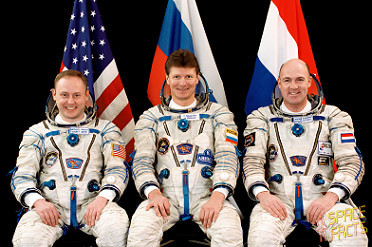
Crew auf dem Weg zum Start |
 |
|||||||||||||||||||||||
alternatives Crewfoto |
alternatives Crewfoto |
|||||||||||||||||||||||
alternatives Crewfoto |
alternatives Crewfoto |
|||||||||||||||||||||||
alternatives Crewfoto |
alternatives Crewfoto |
|||||||||||||||||||||||
Besatzung
| Nr. | Name | Vorname | Position | Flug-Nr. | Flugdauer | Erdorbits | |
| 1 |  |
Padalka | Gennadi Iwanowitsch | Kommandant | 2 | 187d 21h 16m 09s | 2952 |
| 2 |  |
Kuipers | André | Flugingenieur | 1 | 10d 20h 52m 15s | 171 |
| 3 |  |
Fincke | Edward Michael "Mike" | Flugingenieur | 1 | 187d 21h 16m 09s | 2952 |
Sitzverteilung der Besatzung
|
 |
|
||||||||||||||||
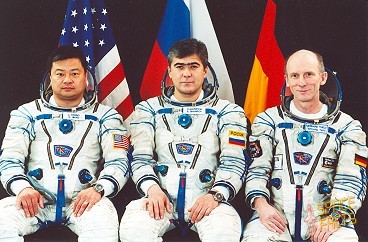
Double Crew
|
 |
||||||||||||||||||||
alternatives Crewfoto |
|||||||||||||||||||||
alternatives Crewfoto |

Hardware
| Trägerrakete: | Sojus-FG (Nr. 25M132S Sh15000-009) |
| Raumschiff: | Sojus TMA-4 (TMA Nr. 214) |
Flugverlauf
|
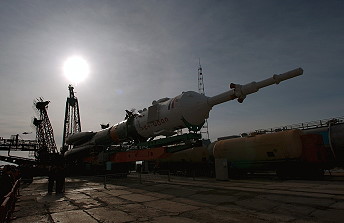
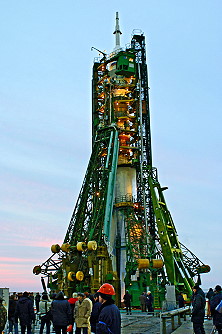
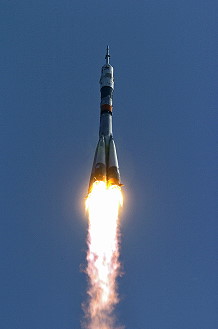
Das Raumschiff startete vom Kosmodrom Baikonur
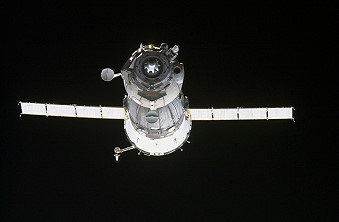
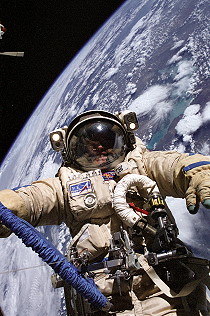
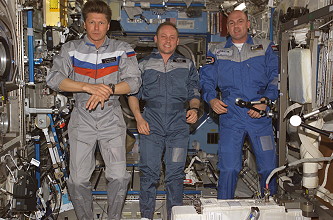
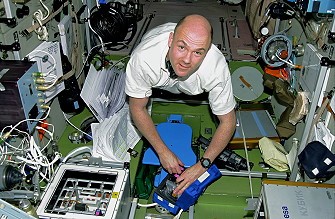
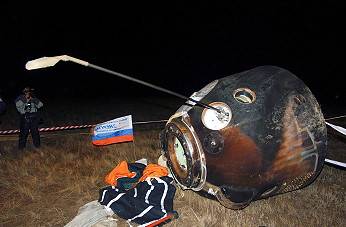
und landete 84 km nordöstlich von Arkalyk. Hauptaufgabe der Mission war es, die ISS Expedition 9 zur Raumstation zu bringen. Die Mannschaft wurde als "Caretaker"-Crew bezeichnet. Nach zweitägigem Alleinflug koppelte Sojus TMA-4 am 21.April 2004 an die ISS an. Gennadi Padalka und Michael Fincke bildeten die neue ISS-Stammbesatzung. Zunächst führte André Kuipers Forschungsarbeiten im Rahmen des europäischen Programms Delta durch. Gennadi Padalka und Michael Fincke flogen zusammen mit dem niederländischen ESA-Astronauten André Kuipers in dem russischen Raumschiff Sojus TMA-4 zur ISS. Nach einer Woche gemeinsamen Arbeitens übernahmen Gennadi Padalka und Michael Fincke die Station offiziell vom ISS-Kommandanten Michael Foale und ISS-Bordingenieur Alexander Kaleri. Die ISS Expedition 8 verließ am 29. April 2004 zusammen mit André Kuipers die Station und kehrte in Sojus TMA-3 zur Erde zurück. André Kuipers' elftägige Mission an Bord der ISS fand im Rahmen eines Abkommens zwischen der Europäischen und der russischen Raumfahrtbehörde statt. Der unbemannte russische Frachter Progress M-49 legte am 27. Mai 2004 um 13:54:43 UTC an der Internationalen Raumstation an. Er war am 25. Mai 2004 um 12:34:23 UTC vom Kosmodrom Baikonur gestartet. Das Transport-Raumschiff brachte Versorgungs- und Ausrüstungsgegenstände wie Lebensmittel, Wasser und Sauerstoff zur Stammbesatzung. Am 30. Juli 2004 um 06:04:48 UTC koppelte Progress M-49 wieder ab. Der Frachter wurde kontrolliert zum Absturz gebracht und verglühte am gleichen Tag über dem Pazifischen Ozean. Im Verlauf des Fluges standen umfangreiche wissenschaftliche Forschungen auf dem Arbeitsprogramm der 9. Stammbesatzung der Internationalen Raumstation. Aufgrund der auf 2 Mann reduzierten Crew rückten allerdings Wartungs- und Reparatureinsätze zunehmend in den Mittelpunkt und nahmen neben sportlicher Betätigung einen Großteil der zur Verfügung stehenden Zeit in Anspruch. Bereits während der Kommandoübergabe am 22. April 2004 wurde den Raumfahrern mitgeteilt, dass sich das Drehmomenten-Gyroskop 2 (Control Moment Gyroscope 2) am Vortage aufgrund eines ausgefallenen Energiefernsteuerungsmoduls (Remote Power Control Module, RPCM) abgeschaltet hatte. Zu diesem Zeitpunkt arbeiteten mit den Einheiten 3 und 4 nur noch zwei der ursprünglich 4 Lageregelungskreisel. CGM 1 verweigerte bereits seit dem 08. Juni 2002 den Dienst und sollte bei einer Shuttle-Mission unmittelbar nach Wiederaufnahme der Flüge im Jahre 2005 ausgetauscht werden. Zwei Lageregelungseinheiten reichen jedoch aus, um die Orientierung der Station im Raum präzise zu steuern. Außerdem verfügt das russische Segment über eine eigene Lageregelung mittels kleiner Triebwerke. Die Missionskontrolle auf der Erde begann aber mit der Planung eines Außenbordeinsatzes zum Austausch des Steuerungsmoduls. Während der Expedition 9 wurde eine Vielzahl größtenteils automatisch ablaufender Experimente betreut und gewartet. Dazu gehörte das Auswechseln von Probenbehältern, Reinigungsarbeiten, das Aufladen oder Austauschen von Batterien, das Übertragen von Messdaten von lokalen Datenträgern ins Stationsnetzwerk bzw. zur Erde, Funktionstests sowie die eine oder andere Reparatur. Zum wissenschaftlichen Programm gehörten Experimente zur Medizin, Erdbeobachtung, Biologie, Materialwissenschaft und Raumfahrttechnologie. Ohne zusätzlichen Materialaufwand liefen Untersuchungen zu natürlichen und vom Menschen verursachten Phänomenen auf der Erde und in der Erdatmosphäre (Experimente: Crew Earth Observation, ESTER, Biotomeja, Uragan, Molnija SM), zu Strukturen auf der Erdoberfläche durch die Fernbedienung einer Stationskamera durch Schülergruppen auf der Erde (EarthKAM), zur Zusammenarbeit zwischen Stations- und Bodencrew (Crew Interactions), zu Strahlungs- und Beschleunigungsmessungen innerhalb der Station (Radiation Monitoring, Prognos, BraDos, MAMS, SAMS) sowie verschiedene außenbords angebrachte Materialtests (Kromka, MPAC, SEED, MISSE, Meteoroid) ab. Ebenfalls ohne Betreuung liefen der Test eines Systems zur Nutzung eines globalen Zeitsignals (Global Time System), die Aufzeichnung der Bewegungsparameter der Station sowie der Test von Vorhersagesystemen (Tensor, Vektor T, Izgib) und die Suche nach schweren solaren und galaktischen Kernen (Platan). Einige der auf Swesdas Außenhaut angebrachten Proben wurden in unregelmäßigen Abständen gewechselt und die Ergebnisse eingelagert oder zur näheren Untersuchung auf die Erde zurückgebracht. Erwähnt seien hier noch einige weitere Experimente. Bei Advanced Diagnostic Ultrasound in Micro-Gravity (ADUM-G), wurde ein Ultraschallsystem zur bildlichen Darstellung innerer Organe und Feststellung von Veränderungen verwendet. Das Capillary Flow Experiment untersuchte die Bewegungen von Flüssigkeiten in Kapillargefäßen in der Schwerelosigkeit. Ziel der Forschungen könnten Pumpensysteme sein, die ohne jegliche bewegliche Mechanik auskommen und damit nicht nur einfacher, leichter und billiger, sondern wahrscheinlich auch ausfallsicherer wären. Im Rahmen des physikalischen Experiments Miscible Fluids in Microgravity wurde das Verhalten mischbarer Flüssigkeiten in der Schwerelosigkeit studiert. Ohne störende Gravitation werden andere Effekte messbar, die sonst durch die Schwerkraft überdeckt werden. Zum Komplex der Strahlungsmessung dagegen gehörte Flourescence Orbital Radiation Risk Assessment using Yeast. Dabei wurden floureszierende Hefekulturen versuchsweise als Indikatoren für aufsummierte Strahlenbelastung verwendet. Die EVA 1 durch Gennadi Padalka und Michael Fincke am 24. Juni 2004 musste nach 13 Minuten abgebrochen werden. Aufgrund einer falschen Schalterstellung (Fehlbedienung) sank der Druck im primären Sauerstofftank des Raumanzuges von Michael Fincke stärker als vorgesehen. Dadurch wurde Michael Finckes Ausstieg mit 14 Minuten Dauer zum kürzesten US-Außenbordeinsatz. Geplant war eine EVA von 6 Stunden. Die zweite EVA unternahmen Gennadi Padalka und Michael Fincke am 30. Juni 2004 (5h 40m). Dabei gelang der Austausch eines Steuergerätes. Dabei wurden die Raumfahrer bei Ausstieg und Wiedereinstieg sowie beim Hinüberschwenken zum US-Segment mit Hilfe eines teleskopartig ausfahrbaren Kranarms vom Typ Strela durch das russische Kontrollzentrum betreut, während der eigentlichen Reparatur durch das in den USA. Zusätzlich wurden am russischen Segment Geräte zur Messung von Triebwerksabgasen installiert. Außerdem wurden zwei flexible Handläufe und die Endstücke zweier weiterer Handläufe angebracht und ein Monitor montiert, der Verunreinigungen an der Außenhaut der Station messen sollte. Die dritte EVA wurde ebenfalls durch Gennadi Padalka und Michael Fincke am 03. August 2004 (4h 30m) ausgeführt. Sie diente dem Austausch verschiedener außenbords angebrachter Material- und Messexperimente sowie zur Montage von vier neuen Laserreflektoren am Heckkopplungs-Aggregat von Swesda, die bei der geplanten Annäherung des ESA-Frachters Automated Transfer Vehicle (ATV) benötigt wurden. Dabei wurden sechs ältere Reflektoren entfernt. Nach diesen Arbeiten wurden noch während des Ausstiegs Lageregelungstriebwerke eingesetzt, um die Lage der Station zu korrigieren. Die sonst meist dafür eingesetzten Gyroskope im Gittermodul Z1 waren bereits auf Maximaldrehzahl gesättigt und wurden zu einem späteren Zeitpunkt wieder einsatzbereit gemacht. Der unbemannte russische Frachter Progress M-50 legte am 14. August 2004 um 05:01:08 UTC an der Internationalen Raumstation an. Er war am 11. August 2004 um 05:03:07 UTC vom Kosmodrom Baikonur gestartet. Das Transport-Raumschiff brachte Versorgungs- und Ausrüstungsgegenstände wie Lebensmittel, Wasser und Sauerstoff zur Stammbesatzung. Am 22. Dezember 2004 um 19:37:02 UTC koppelte Progress M-50 wieder ab. Der Frachter wurde kontrolliert zum Absturz gebracht und verglühte am gleichen Tag über dem Pazifischen Ozean. Am 17. August 2004 installierten Gennadi Padalka und Michael Fincke im Frachtraumschiff Progress M-50 Systeme zur Steuerung der Triebwerke aus dem Servicemodul Swesda heraus. Durch längere Triebwerkszündungen des am Heck der Station angekoppelten Frachters wurde die Bahnhöhe in den folgenden Tagen mehrfach um mehrere Kilometer angehoben. Außerdem arbeitete man an der Reparatur der US-amerikanischen Raumanzüge weiter. Die vierte und letzte EVA durch Gennadi Padalka und Michael Fincke erfolgte am 03. September 2004 (5h 21m). Dabei wurden am Modul Sarja Wartungsarbeiten ausgeführt und an Swesda Antennen für ein spezielles Annäherungssystem der ESA montiert. Auch dies diente dem geplanten Rendezvous mit dem europäischen ATV. Abschließend führten sie Wartungsarbeiten am Kopplungs- und Ausstiegsmodul Pirs durch. Am 08. September 2004 schaltete sich das System zur Sauerstofferzeugung durch Elektrolyse Elektron im Modul Swesda selbsttätig ab. Erste Reaktivierungsversuche führten nicht zum gewünschten Erfolg, sodass umfangreichere Reparaturarbeiten notwendig wurden. Danach arbeitete Elektron zunächst wieder, allerdings mit höherem Wartungsaufwand. In ihren Raumanzügen hatten die Kosmonauten ihre Plätze im Landemodul eingenommen, nachdem sie die Luke zur Orbitalsektion geschlossen hatten. Dann richteten sie das Raumschiff so aus, dass das Triebwerk des Geräteteils in Flugrichtung zeigte. Dieses wurde kurz darauf für 260,3 Sekunden gezündet und leitete den Abstieg zur Erdoberfläche ein. Im nächsten Schritt erfolgte das planmäßige Abtrennen der Orbitalsektion und des Geräteteils, die beide in der Erdatmosphäre verglühten. Das verbleibende Landemodul wurde so ausgerichtet, dass der Eintrittswinkel für eine möglichst genaue Landung in Kasachstan erreicht wurde. Nach dem Eintritt in die Erdatmosphäre brach der Funkkontakt wegen der heißen Plasmagase rund um die Kapsel ab. Dann löste sich der Deckel des Fallschirmbehälters und der Bremsfallschirm wurde ausgestoßen. Nachdem auch der Hitzeschutzschild abgetrennt worden war, schwebte die Sojus an ihrem Hauptfallschirm Richtung Erdboden. Kleine Feststoff-Bremsraketen, die kurz vor dem Berühren des Bodens ausgelöst worden waren, verminderten die Aufprallgeschwindigkeit. Sofort nach der erfolgreichen Landung wurden die Fallschirmleinen gekappt, damit die Kapsel nicht durch den Wind über den Boden gezogen werden konnte. Nach der Landung gehört es zum Ritual, dass die Kosmonauten das Raumschiff mit ihrer Unterschrift versehen. Während ihres Aufenthaltes an Bord der ISS führte die Crew der Expedition 9 folgende wissenschaftliche Experimente durch (vollständige Auflistung): Actin (Role of Weightlessness on Metabolism), ADUM (Advanced Diagnostic Ultrasound in Microgravity), ARISS (Amateur Radio on the International Space Station), BCAT-3-4-CP (Binary Colloidal Alloy Test - 3 and 4: Critical Point), BCAT-3-SC (Binary Colloidal Alloy Test - 3: Surface Crystallization), Biodegradation (Initial stage of Biodegradation and Biodeterioration in Space), Bioekologia (Generation of High Efficiency of Microorganisms for the Production of Preparations of Biodegradable Oil, Organophosphorus Material, Measures for the Protection of Plants, as well as, of Exopolysaddharides Uses in the Petroleum Industry), Biopsy (Effect of Prolonged Space Flight on Human Skeletal Muscle), Biorisk (Influence of Factors of the Space Environment on the Condition of the System of Microorganisms-Hosts Relating to the Problem of Environmental Safety of Flight Techniques and Planetary Quarantine), Biotest (Biochemical Status of Humans in Long Duration Space Flight), Brados (Acquisition of Data About the Radiological, Electromagnetic and Different Physical Environments on Board ISS, and Their Effects on the Safety of the Crew, Space Equipment and Materials), Cardio-ODNT (Dynamics of the Main Factors of Cardiac Function, of Central and Regional Circulation in Rest and During the Influence of Lower Body Negative Pressure), CEO (Crew Earth Observations), CFE (Capillary Flow Experiment), Clinical Nutrition Assessment (Clinical Nutrition Assessment of ISS Astronauts, SMO-016E), Conjugation (Development of Methods for Designing New Recombinants Producing Strains of Bacteria in Space Flight), Diatomeya (Stability of Geographical Position and Configuration of Borders of Bioproductive Water Zones of the World Oceans, Observations by Orbition Station Crews), Diurez (Fluid and Electrolyte Metabolism and Hormonal Regulaltion of Fluid Volume), EarthKAM (Earth Knowledge Acquired by Middle School Students), Ekon (Experimental Survey on Evaluating the Possibility of Using th Russian Segment of ISS for Environmental Inspection of Work Areas of Various Facilities (Features)), Environmental Monitoring (Environmental Monitoring of the International Space Station), EPO (Education Payload Operations), EPO-Demos (Education Payload Operation - Demonstrations), ETD (Eye Tracking Device), Farma (Characteristics of Pharmacological Responses (absorption, distribution and elimination of acetominophene) in Long Duration Space Flight), FMVM (Fluid Merging Viscosity Measurement), Foam (Viscous Liquid Foam - Bulk Metallic Glass), Gematologia (Morphofunctional Characteristic of Blood Cells and the Intensity of Erythropoiesis in Humans by the Influence of Factors of Space Flight), Heart (Physiological Parameters that Predict Orthostatic Intolerance After Spaceflight), ICE-First-Muscle Proteins (International Caenorhabditis elegans Experiment First Flight-Muscle Proteins), Identifikatsia (Identification of the Sources of Dynamic Loads on ISS), Inflight Education Downlinks (International Space Station Inflight Education Downlinks), Interactions (Crewmember and Crew-Ground Interaction During International Space Station Missions), Interleukin-K (Production of Hight Quality Crystals of Interleukin -1Alpha, -1Beta and Receptor of Antagonist of Interleukin-1), Iskazheniye (Determination and Analysis of Magnetic Interference on ISS), ISSI (In Space Soldering Investigation), ISS Acoustics (International Space Station Acoustic Measurement Program), Izgib (Effect of Performance of Flight and Science Activities on the Function of On-Orbit Systems on ISS (Mathematical Model)), JAXA-GCF (Japan Aerospace and Exploration Agency - Granada Crystallization Facility High Quality Protein Crystallization Project), Journals (Behavioral Issues Associated with isolation and Confinement: Review and Analysis of Astronaut Journals), Kromka (Verification of the Effectiveness of Devices for the Protection of the Exterior Surface of ISS from Contaminants Deposited by Pulsed Cycling of Liquid-Jet), Meteoroid (Recording Meteoroidal and Technogenic Particles on the External Surface of the Service Module of the Russian Segment of ISS), Mezhkletochnoe Vzaimodeistvie (Intercellular Interactions in Space Flight), MFMG (Miscible Fluids in Microgravity), Mimetik-K (Crystalization of antigen Binding Fragment of Monoclonalical Antibody to Glucosaminilmuramildepeptide), MISSE-1 and 2 (Materials International Space Station Experiment - 1 and 2), Mobility (Promoting Sensorimotor Response Generalizability: A Countermeasure to Mitigate Locomotor Dysfunction After Long-Duration Space Flight), Molniya-SM (Investigation of Lightning Discharges in the Earth's Atmosphere and Lower Ionosphere), MOP (Motion Perception: Vestibular Adaptation to G-Transitions), Muscle (Study of Low Back Pain in Crewmembers During Space Flight), PCG-STES-RGE (Protein Crystal Growth-Single Locker Thermal Enclosure System-Regulation of Gene Expression), PCG-STES-SA (Protein Crystal Growth-Single Locker Thermal Enclosure System-Science and Applications of Facility Hardware for Protein Crystal Growth), Pilot (Individual Characteristics of Psychophysiological Regulatory Status and Reliaility of Professional Activities of Cosmonauts in Long Duration Space Flight), Plasma_Crystal (Dusty and Liquid Plasma Crystals in Conditions of Microgravity), Platan (Search for Low Energy Heavy Particles of Solar and Galactic Origin), Plazmida (Transfer of Molecules of DNA by Conjugation in Space Flight), Privyazka (Development of High Precision Orientation of Scientific Devices in Space with Reports of Deformation of the ISS Hull), Profilaktika (Mechanisms of Action and Influence, and Effectiveness of Various Methods of Phrophylaxis Directed Toward Prevention of Disturbances of the Human Locomotion System in Weightlessness), Prognoz (Development of a Method of Operational Prediction of Work Load on Crew Piloting Objectives), Pulse (Vegatative (Autonomic) Regulation of the Cardio-Respiratory System of Humans in Conditions of Weightlessness), Rastenia (Growth and Development of Higher Plants through Multiple Generations), Relaksatia (Processes of Relaxation in the Ultraviolet Band Spectrum by High Velocity Interaction of Exhaust Products on ISS), Sample (Study of Microbial Communities Exposed to Weightlessness), Seeds (Seeds in Space), SKR (Skorpion: Development and Acquisition of Multifunctional Control-Measurement Device for Controlling the Environment of Scientific Experiments Inside a Pressurized Station), SNFM (Serial Network Flow Monitor), Sprut-MBI (Determination of Intracellular and Extracellular Fluid Volume in Humans in Space Flight), Tenzor (Definition of Dynamic Characteristics of ISS), Toksichnost (Development of a Metod of Express Monitoring of Toxicity of Water in Space Flight), Uragan (Hurricane: Experimental Development of Groundbased System of Monitoring and Predicting the Progression of a Naturally Occurring Technogenic Catastrophe), Vaktsina-K (Structural Study of Protein Candidats in a Vaccine for AIDS on Earth and in Space), Vektor-T (Study of a High Precision System for Prediction Motion of ISS). |
EVA-Daten
| Name | Beginn | Ende | Dauer | Mission | Schleuse | Anzug | Streifen | |
| EVA | Fincke, Michael | 24.06.2004, 21:57 UTC | 24.06.2004, 22:10 UTC | 0h 13m | ISS-09 | ISS - Pirs | Orlan-M Nr. 26 | blau |
| IVA | Padalka, Gennadi | 24.06.2004, 21:57 UTC | 24.06.2004, 22:10 UTC | 0h 13m | ISS-09 | ISS - Pirs | Orlan-M Nr. 25 | rot |
| EVA | Fincke, Michael | 30.06.2004, 21:19 UTC | 01.07.2004, 02:59 UTC | 5h 40m | ISS-09 | ISS - Pirs | Orlan-M Nr. 26 | blau |
| EVA | Padalka, Gennadi | 30.06.2004, 21:19 UTC | 01.07.2004, 02:59 UTC | 5h 40m | ISS-09 | ISS - Pirs | Orlan-M Nr. 25 | rot |
| EVA | Fincke, Michael | 03.08.2004, 06:58 UTC | 03.08.2004, 11:28 UTC | 4h 30m | ISS-09 | ISS - Pirs | Orlan-M Nr. 26 | blau |
| EVA | Padalka, Gennadi | 03.08.2004, 06:58 UTC | 03.08.2004, 11:28 UTC | 4h 30m | ISS-09 | ISS - Pirs | Orlan-M Nr. 25 | rot |
| EVA | Fincke, Michael | 03.09.2004, 16:43 UTC | 03.09.2004, 22:04 UTC | 5h 21m | ISS-09 | ISS - Pirs | Orlan-M Nr. 26 | blau |
| EVA | Padalka, Gennadi | 03.09.2004, 16:43 UTC | 03.09.2004, 22:04 UTC | 5h 21m | ISS-09 | ISS - Pirs | Orlan-M Nr. 25 | rot |
Anmerkung
Fotos / Grafiken
 |
 |
|
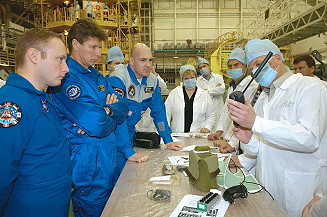
Quello für alle Fotos ist Roskosmos / NASA |
|
 |
 |
 |
 |
 |
 |
 |
 |
 |
 |
mehr EVA-Fotos |
|
| © |  |
Letztes Update am 11. November 2023.  |
 |