Launch from Cape Canaveral and landing
southeast of Bermuda Islands in the Atlantic Ocean.
Apollo 7 was the only manned
Apollo launch to take place from Cape Kennedy Air
Force Station's Launch Complex 34. All subsequent
Apollo and
Skylab missions (including
Apollo-Soyuz) were launched from Launch
Complex 39 at the nearby Kennedy Space Center, and Launch Complex 34 was
retired.
The
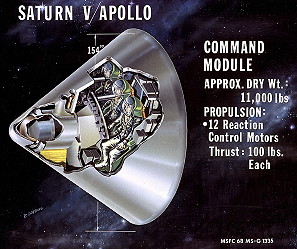
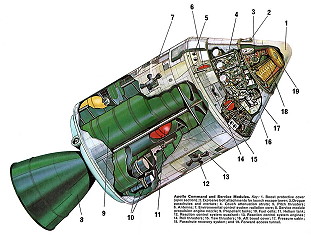
Command Module (CM) was a conical pressure vessel
with a maximum diameter of 3.9 m at its base and a height of 3.65 m. It was
made of an aluminum honeycomb sandwich bonded between sheet aluminum alloy. The
base of the CM consisted of a heat shield made of brazed stainless steel
honeycomb filled with a phenolic epoxy resin as an ablative material and varied
in thickness from 1.8 to 6.9 cm. At the tip of the cone was a hatch and docking
assembly designed to mate with the lunar module. The CM was divided into three
compartments. The forward compartment in the nose of the cone held the three
25.4 m diameter main parachutes, two 5 m drogue parachutes, and pilot mortar
chutes for Earth landing. The aft compartment was situated around the base of
the CM and contained propellant tanks, reaction control engines, wiring, and
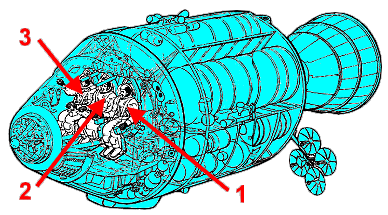
plumbing. The crew compartment comprised most of the volume of the CM,
approximately 6.17 cubic meters of space. Three astronaut couches were lined up
facing forward in the center of the compartment. A large access hatch was
situated above the center couch. A short access tunnel led to the docking hatch
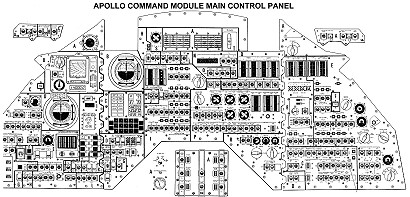
in the CM nose. The crew compartment held the controls, displays, navigation
equipment and other systems used by the astronauts. The CM had five windows:
one in the access hatch, one next to each astronaut in the two outer seats, and
two forward-facing rendezvous windows. Five silver/zinc-oxide batteries
provided power after the CM and SM detached, three for re-entry and after
landing and two for vehicle separation and parachute deployment. The CM had
twelve 420 N nitrogen tetroxide/hydrazine reaction control thrusters. The CM
provided the re-entry capability at the end of the mission after separation
from the Service Module.
The
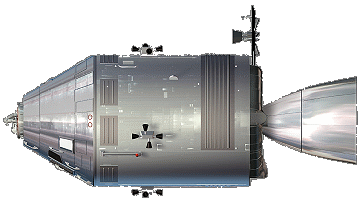
Service Module (SM) was a cylinder 3.9
meters in diameter and 7.6 m long which was attached to the back of the CM. The
outer skin of the SM was formed of 2.5 cm thick aluminum honeycomb panels. The
interior was divided by milled aluminum radial beams into six sections around a
central cylinder. At the back of the SM mounted in the central cylinder was a
gimbal mounted re-startable hypergolic liquid propellant 91,000 N engine and
cone shaped engine nozzle. Attitude control was provided by four identical
banks of four 450 N reaction control thrusters each spaced 90 degrees apart
around the forward part of the SM. The six sections of the SM held three
31-cell hydrogen oxygen fuel cells which provided 28 volts, two cryogenic
oxygen and two cryogenic hydrogen tanks, four tanks for the main propulsion
engine, two for fuel and two for oxidizer, and the subsystems the main
propulsion unit. Two helium tanks were mounted in the central cylinder.
Electrical power system radiators were at the top of the cylinder and
environmental control radiator panels spaced around the bottom.
Apollo 7 marked the first
NASA mission after the
Apollo 1
launch pad fire. It was also the first crew of three American astronauts.
The mission was a test flight of the modificated
Apollo spacecraft. The crew performed rendezvous
exercises with the upper stage of the Saturn 1-B launch vehicle and provided
the first TV pictures from a U.S. spacecraft.
After launch at 15:02:45
UTC on October 11, 1968, The S-IVB/
CSM was put into a 228 x 282 km Earth orbit. Venting
of S-IVB propellants raised the orbit to 232 x 309 km over the next three
hours, at which time the S-IVB stage was separated from the
CSM. The S-IVB stage was then used for rendezvous
maneuvers over the next two days.
All three astronauts developed a bad
cold. Additionally, one of the three fuel cells supplying electricity to the
craft developed some unwanted high temperatures and the coolant lines sweated
and water collected in little puddles on the deck. The crew vacuumed the excess
water out into space with the urine dump hose. Looking through the five capsule
windows therefore was not good at the beginning of the mission; two of the
windows had soot deposits and two others had water condensation, but a few days
later the windows were adequate. So, the crew could perform observations and
navigational sightings with a telescope and a sextant.
The bad cold of
the astronauts caught another problem. Mucus accumulates, filling the nasal
passages, and does not drain from the head. The only relief is to blow hard,
which is painful to the ear drums. So, the crewmen of
Apollo 7 whirled through space suffering from stopped
up ears and noses. Aspirin and decongestant tablets helped during the mission.
The next problem was indeed the landing, the crew began to worry about wearing
their suit helmets during reentry, which would prevent them from blowing their
noses. The buildup of pressure might burst their eardrums, several discussions
followed and especially Commander Walter
Schirra was adamant. At least, mission control
“won” and the astronauts each took a decongestant pill about an hour
before reentry and made it through the acceleration zone without any problems
with their ears.
The most serious problem during reentry was the
overheating of fuel cells, which might have failed when the spacecraft was too
far from Earth to return on batteries, even if fully charged. But each anomaly
was satisfactorily checked out before the next mission.
The crew was
recovered by the
USS
Essex.