Resident Crews of the International Space Station (ISS)

ISS: Expedition 6 |
 |

alternative crew photoalternative crew photooriginal crew photo |
 |
 |
|
Crew, launch- and landing data
| No. | Nation | Surname | Given names | Position | Spacecraft (launch) |
Launch date |
Launch time |
Spacecraft (landing) |
Landing date |
Landing time |
Mission duration |
Orbits |
| 1 |  |
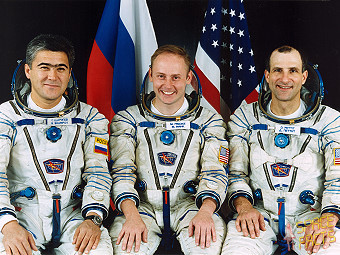
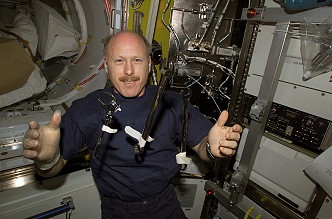
Bowersox | Kenneth Dwane "Sox" | ISS-CDR | STS-113 | 24.11.2002 | 00:49:47.021 UTC | Soyuz TMA-1 | 04.05.2003 | 02:04:25 UTC | 161d 01h 14m 38s | 2534 |
| 2 |  |
Budarin | Nikolai Mikhailovich | Flight Engineer-1 | STS-113 | 24.11.2002 | 00:49:47.021 UTC | Soyuz TMA-1 | 04.05.2003 | 02:04:25 UTC | 161d 01h 14m 38s | 2534 |
| 3 | |
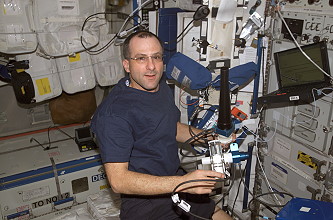
Pettit | Donald Roy | Flight Engineer-2 | STS-113 | 24.11.2002 | 00:49:47.021 UTC | Soyuz TMA-1 | 04.05.2003 | 02:04:25 UTC | 161d 01h 14m 38s | 2534 |
Backup Crew
| No. | Nation | Surname | Given names | Position |
| 1 | |
Sharipov | Salizhan Shakirovich | ISS-CDR |
| 2 | |
Fincke | Edward Michael "Mike" | Flight Engineer |
 |
 |
Expedition Report
|
Expedition 6 launched with
STS-113 from
Cape Canaveral (KSC). The crew landed with
Soyuz TMA-1
460 km southwest of the intended site in Kazakhstan (49°27'48'' N,
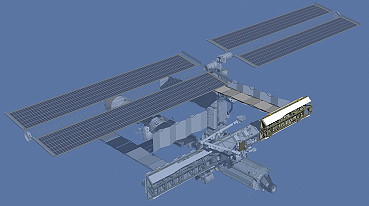
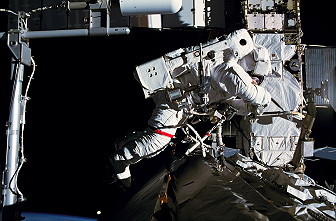
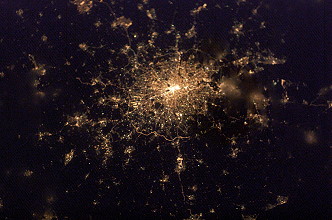
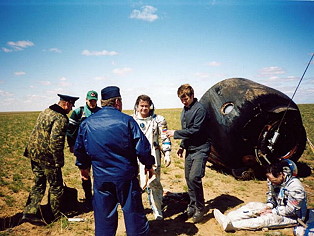
61°20'36'' E). The Expedition 6 officially began with undocking of Space Shuttle STS-113 on December 02, 2002 at 20:50:00 UTC and Expedition 5 ended. On November 25, 2002 Space Shuttle STS-113 docked with the International Space Station. STS-113 was the 16th American (ISS-16-11A) assembly flight to the International Space Station (ISS). The primary mission was to bring the Expedition 6 crew to the ISS and return the Expedition 5 crew to the Earth. In addition to the crew exchange, STS-113 was the next flight in the assembly sequence to install a major component, the Port 1 (P1) Integrated Truss Assembly. Three spacewalks were carried out to install and activate the truss and its associated equipment. The major objective of the mission was delivery of the 45-foot-long (13.7 meters), 14-ton P1 to the ISS. The segment, identical to the one delivered on the recent STS-112 flight, was attached to the port side of the centerpiece truss, the S-Zero (S0), which is home to the Mobile Transporter (MT), Mobile Base System (MBS) and the Canadarm2 robotic arm. P1 continued the outboard expansion of the station's rail system in preparation for the addition of new power and international science modules in the years to come. With the addition of P1, the station's truss spans 134 feet (40.8 meters). The 27,506 lb. (12,477 kg) P1 Truss is primarily an aluminum structure that is 45 feet (13.7 meters) long, 13 feet (4.0 meters) high and 15 feet (4.6 meters) wide. The structure, along with one CETA (Crew and Equipment Translation Aid) cart, costs about $390 million. P1 contains the Active Thermal Control System (ATCS) for the station that was activated later. This system serves a similar purpose to an automobile's radiator except this system uses 99.9 percent pure ammonia. Additionally, the P1 houses a second Ultra High Frequency (UHF) communications system to provide enhanced and extended voice and data capability, and a second mobile work platform for spacewalkers called the Crew and Equipment Translation Aid (CETA) cart. Like the S1, the P1 includes a Thermal Radiator Rotary Joint (TRRJ), which will provide the mechanical and electrical energy for rotating the station's heat-rejecting radiators. P1 is the fourth of 11 truss structures that ultimately will expand the ISS to the length of a football field and increase its power through the addition of new photovoltaic modules and solar arrays. The docking set the stage for the opening of the hatches and the start of seven days of joint operations, including the fifth transition of one station crew to another. The following day, Michael Lopez-Alegria and John Herrington began spacewalk preparations while James Wetherbee used the shuttle's robotic arm to lift the huge P1 Truss out of Endeavour's payload bay to hand it to the station's Canadarm2 under control of Peggy Whitson inside Destiny. She then carefully installed it on the port side of the S0 Truss. Capture bolts structurally mated the two trusses after a claw-like device on the S0 grabs a fixture on the P1 segment. The procedure was timed so that the two spacewalkers did not exit the station's Quest Airlock until the mating process is complete. The first EVA by Michael Lopez-Alegria and John Herrington occurred on November 26, 2002 (6h 45m) to hook up connections between the P1 and S0 trusses and other installations. Before Michael Lopez-Alegria and John Herrington emerged from the airlock, James Wetherbee used the shuttle's robotic arm to grapple P1 and lifted it from the payload bay, then handed it off to the station's Canadarm2, operated by Peggy Whitson and Kenneth Bowersox. They moved P1 to the end of S0. After a claw attached itself to P1 and drawed it into position and bolts secured ends of the two segments, Michael Lopez-Alegria and John Herrington emerged from the Joint Airlock and began setting up for the first spacewalk. Once he was clear of the airlock, John Herrington moved to the rail lines along P1, where he released CETA cart launch latches, a two-hour and 20-minute job. The task involved releasing a total of 24 bolts. First among them were the cart's brake system bolts; their removal enabled the CETA's brakes to be used. Meanwhile, Michael Lopez-Alegria maneuvered to the cable tray on the bottom of P1. Working from a portable foot restraint, he opened covers of cable trays on the lower sides of S0 and P1, then demated connectors on the S0 side from temporary attachment points and connected their free ends to receptacles on P1. After that task, Michael Lopez-Alegria began installation of four 1 ½-inch (3.8 centimeters) SPD on Flex Hose Rotary Coupler (FHRC) Quick Disconnects (QDs). He then moved inboard along P1 to the truss' bay 12 and installed two more 1½-inch (3.8 centimeters) SPDs. SPDs are devices that maintain the QDs, in ammonia lines that are part of the station's cooling system, in a position to enable them to function optimally. The installation of the 1 ½-inch (3.8 centimeters) SPDs involves installing the aft part of the SPD, then moving a bail (QD valve) back about ¼-in (0.6 centimeter) and installing the forward part of the SPD. This keeps the QD valve in a fixed position. Back together again, John Herrington and Michael Lopez-Alegria moved on to P1's starboard drag link, located on the forward face of the truss. They worked together to release that drag link, a large metal rod used as a launch restraint. Michael Lopez-Alegria released a bolt attaching the drag link to P1, while John Herrington released a similar bolt attaching the drag link to the keel. Michael Lopez-Alegria took the drag link to its stowage location on the P1 framework and attached it with John Herrington's assistance. The processes were repeated on the P1 port drag link. That task completed, Michael Lopez-Alegria moved to the cable tray atop P1. There he made additional connections, opening thermal covers over cable trays atop S0 and P1, then demating connectors on the S0 side from temporary attachment points and connecting their free ends to receptacles on P1. After that task, Michael Lopez-Alegria and John Herrington, who had done some additional work on the CETA, combined on the final major task of the spacewalk, a two-hour installation on the Unity Node of the first WETA, designed to support spacewalkers' helmet cameras. Michael Lopez-Alegria moved to the P1's starboard keel pin, retrieved the WETA stanchion and took it to the Joint Airlock. There he and John Herrington spent about 15 minutes attaching the WETA to the stanchion. John Herrington retrieved the WETA from its temporary airlock stowage position. While Michael Lopez-Alegria held the WETA in place, John Herrington used a pistolgrip tool to secure a center jacking bolt and then two outer bolts. Michael Lopez-Alegria, with the WETA, and John Herrington moved to the installation location on the node. With help from John Herrington, Michael Lopez-Alegria secured it by driving a stanchion bolt. Subsequently he mated three stanchion power and data connectors to the node. The next day - Flight Day 5 - was highlighted by the formal handover of station command from Expedition 5 to Expedition 6. Kenneth Bowersox, Nikolai Budarin and Donald Pettit served as ISS Expedition Six. The Expedition Five crew Peggy Whitson, Valeri Korzun and Sergei Treshchyov returned to Earth with this mission. The day included inside transfer work and some off duty time before the second spacewalk began on Flight Day 6 to continue the connection of fluid lines between the P1 and the S0 segments, the installation of another wireless video system transceiver on the P1, and the relocation of the CETA cart in preparation for the relocation of the Mobile Transporter. Also, in preparation for the MT relocation, the station's Canadarm2 was temporarily moved to a grapple fixture on the outside of Destiny. The second EVA was performed by Michael Lopez-Alegria and John Herrington on November 28, 2002 (6h 10m) to install the fluid jumpers where the S0 and the P1 are attached to each other, to remove the P1's starboard keel pin and to relocate the CETA cart from the P1 to the S1 Truss, which will allow the Mobile Transporter to move along the P1 to assist in upcoming assembly mission. Once they were out of the airlock and setup was complete, Michael Lopez-Alegria and John Herrington moved to a point at the junction of S0 and P1 for a two-hour installation of fluid jumpers to move ammonia between the two. The two released two jumpers on S0, then moved to the jumper install position. Michael Lopez-Alegria mated and installed SPDs on two jumper connections on the S0 side, while John Herrington performed a similar task on the P1 side. Each connection involved a three-minute leak check. Michael Lopez-Alegria and John Herrington reinstalled the thermal booties and together they closed their respective ends of the P1 and S0 utility tray shrouds. Then John Herrington and Michael Lopez-Alegria, the latter on the CETA cart, moved on to P1's starboard keel pin. Michael Lopez-Alegria set the CETA brakes, and at the worksite released the top keel pin bolt, rotated the keel pin, then reinstalled the bolt. He then removed the lower keel pin bolt, freed the keel pin and reinstalled the bolt. John Herrington moved the CETA along with Michael Lopez-Alegria and the keel pin, a few feet down the tracks. From the new location, Michael Lopez-Alegria installed the keel pin in stowage brackets inside the P1 framework, completing the half-hour task. Working together, the spacewalkers moved on to installation of the second WETA, on the P1 itself. This installation was completed in a manner similar to the Node WETA installation. While Michael Lopez-Alegria completed the connections to the P1 WETA, John Herrington performed a test of the Segment-to-Segment Attachment System on the outboard end of P1. Michael Lopez-Alegria and John Herrington then moved on to release of the port keel pin, repeating the tasks performed during release of the starboard keel pin. Finally, they spent a little more than an hour moving the CETA launched on P1 to S1. John Herrington was on the end of Canadarm2, operated by Donald Pettit, for this activity. The two spacewalkers released the CETA from its tracks, moved it around the Mobile Transporter (which supports the Mobile Base System for the Canadarm2), attached it to the tracks again and coupled it to its sister CETA. The third and final EVA was again performed by Michael Lopez-Alegria and John Herrington on November 30, 2002 (7h 00m) to install more SPD's (Spool Positioning Devices), to reconfigure electrical harnesses that route power through the Main Bus Switching Units and to attach Ammonia Tank Assembly lines. The third spacewalk was devoted almost entirely to installation of SPDs. After setup, John Herrington entered a bay in the S0 Truss and operated two CIDs allowing ground controllers to begin work on the MBSU reconfiguration. From there, John Herrington moved to the top center of the P1 Truss and attached a foot restraint at the end of the Canadarm2. John Herrington then ingressed the foot restraint and Donald Pettit, at the arm's controls, maneuvered him to the starboard end of the P1. There John Herrington began the installation of a dozen 1-inch (2.5 centimeters) SPDs on lines linking the Radiator Beam Valve Modules (RBVMs) and the radiator junction box. He then got off the arm and continued with the 1-inch (2.5 centimeters) SPD installations, moving out toward the outboard end of the P1. During this three-hour-plus phase of the spacewalk, John Herrington installed a total of 18 SPDs. Meanwhile Michael Lopez-Alegria installed two 1-inch (2.5 centimeters) SPDs at the Z1 to P6 interface, and then moved to the bottom of the Z1 Truss at its junction with the U.S. laboratory Destiny. There he installed two 1-inch (2.5 centimeters) SPDs. Next, he moved to the Moderate Temperature Loop Heat Exchanger on the lab's exterior, removed a Micro Meteoroid Orbital Debris shield and installed two 1-inch (2.5 centimeters) SPDs, and finally reinstalled the shield. His next task was at the pump module on P1. There he installed three 1½-inch (3.8 centimeters) SPDs and a half-inch (1.3 centimeter) SPD. Michael Lopez-Alegria took a break from SPD installation with his next activity, reconfiguration of electrical harnesses that route through Main Bus Switching Units. That task, involving relocating two dustcaps and changing four cable connections from two foot restraint positions in the interior of the S0 Truss in bay 4, was completed by Michael Lopez-Alegria about four hours into the spacewalk. Following the RBVM SPD installation, John Herrington focused his attention on the Ammonia Tank Assembly (ATA) umbilicals. The P1 ATA is on the starboard-most bay of P1 on the aft face. That job, linking the ATA to ammonia lines in the station's cooling system and the Nitrogen Tank Assembly lines to the ATA, involved relocation of four quick disconnect caps and hookup of four connections. John Herrington also installed one ½-inch (1.3 centimeter) SPD during that process. John Herrington's final task of spacewalk No. 3 was installation of three 1 ½-inch (3.8 centimeters) and one ½-inch (1.3 centimeter) SPDs on S1 Pump Module connector lines. Michael Lopez-Alegria also moved to S1, to install four 1 ½-inch (3.8 centimeters) SPDs on Flex Hose Rotary Coupler (FHRC) QDs. Michael Lopez-Alegria and John Herrington installed more than 40 SPDs during STS-113 spacewalks. The next day the shuttle and station crews completed transfer work and get-ahead tasks for future assembly flights. The Expedition 5 Crew had to bid farewell to its home for five months and the shuttle crew had to bid its Expedition 6 replacements bon voyage as the hatches were closed on Flight Day 10. On December 02, 2002 STS-113 backed away from the ISS to a distance of about 450 feet (137.2 meters), where Paul Lockhart began a close flyaround of the station, much like the one he did on STS-111 in June 2002, circling the complex about one and a quarter times. Paul Lockhart passed a point directly above the station, then behind, then underneath, then in front and then reached a point directly above the station for a second time. At that point, passing above the orbiting laboratory, Paul Lockhart fired Endeavour's jets for final separation from the station. The first EVA in this expedition was performed by Kenneth Bowersox and Donald Pettit on January 15, 2003 (6h 51m) to continue outfitting and activating the International Space Station's newest component, the P1 (P-One) Truss and relocate a toolbox from the Z1 Truss to one of the Crew and Equipment Translation Aid. Kenneth Bowersox and Donald Pettit continued outfitting and activating the International Space Station's newest component, the P1 (P-One) Truss. The P1's radiator assembly was a major focus during the spacewalk. Kenneth Bowersox and Donald Pettit released the remaining launch locks on the radiator assembly, which allowed the radiator assembly to be deployed. Other scheduled tasks completed included removing some debris that was on a sealing ring on the Unity Module's Earth-facing docking port, and they tested an ammonia reservoir on the station's P6 Truss. They were unable to complete one scheduled task - the installation of a light fixture on one of the station's Crew and Equipment Translation Aid, or CETA, carts. The fixture's attachment was rescheduled for a future spacewalk. To complete the spacewalk, Kenneth Bowersox and Donald Pettit cut away a thermal cover strap that apparently interfered with the rotation of the Quest Airlock's hatch and delayed the start of the extravehicular activity. Progress M-47 was launched at 12:59:40 UTC on February 02, 2003. The spacecraft docked with the Aft port of the Zvezda module at 14:49:04 UTC on February 04, 2003. Progress M-47 carried supplies to the International Space Station, including food, water and oxygen for the crew and equipment for conducting scientific research. It was the first spacecraft to launch to the International Space Station following the loss of the Space Shuttle Columbia the day prior to the Progress module's launch, which resulted in a suspension of Shuttle flights to the Station. The freighter remained docked for almost seven months before undocking at 22:48:08 UTC on August 27, 2003 to make way for Progress M-48. It was deorbited at 01:49 UTC the next day. The spacecraft burned up in the atmosphere over the Pacific Ocean, with any remaining debris landing in the ocean at around 02:37:46 UTC. The second EVA by Kenneth Bowersox and Donald Pettit occurred on April 08, 2003 (6h 26m) to reconfigure power connections, provide a second power source for one of the Station's control moment gyroscopes, secure thermal covers on quick disconnect fittings for the station's thermal control system and to get a latch unstuck, which holds down a support for a light on the Crew and Equipment Translation Aid (CETA) carts. Kenneth Bowersox and Donald Pettit reconfigured cables on the S0 (S-Zero), S1 and P1 Trusses for future Integrated Truss Structure component deliveries and replaced a Power Control Module on the Mobile Transporter. They provided Control Moment Gyro No. 2 with a redundant power channel capability by rerouting cables. Then, they installed Spool Positioning Devices on Destiny Laboratory heat exchangers and reinstalled a thermal cover on an S1 Radiator Beam Valve Module. Kenneth Bowersox and Donald Pettit also unfurled a light stanchion on the CETA cart that did not unfurl properly during their first spacewalk. The mission was expected to be a four months mission that was to end in March 2003 when STS-114 was to fly to the Station with the Expedition 7 crew. The Columbia disaster changed plans and the crew stayed on the station until May 2003. They returned to Earth on Soyuz TMA-1 and a reduced Expedition 7 crew with just two members was delivered to the ISS on Soyuz TMA-2. The Space Shuttle was expected to be grounded for up to two years. Ongoing logistical support for the ISS would have to be carried out by Soyuz and Progress flights until the Space Shuttle returned to flight. They were replaced by a crew of two, because of changed flight plans after the Columbia tragedy. The landing was more dramatically than planned. The new Soyuz TMA-1 capsule, used for the first time as a lifeboat, made a ballistic landing after a computer failure, resulting in a high deceleration force (8 g) and a high-anxiety off-course landing 460 km far from the planned landing point, north of the Aral Sea. It took four hours, before the rescue team could safe them. Statements then were that the crew was not injured only Donald Pettit had some problems with gravity effects. Later on. the news said that Donald Pettit injured his shoulder badly during that landing. Amateur Radio on the International Space Station (ARISS): Ever since the Amateur Radio on the International Space Station (ARISS) hardware was first launched aboard space shuttle Atlantis on STS-106 and transferred to ISS during Expedition 1, it has been regularly used to perform school contacts. With the help of Amateur Radio Clubs and ham radio operators, astronauts and cosmonauts aboard the International Space Station (ISS) have been speaking directly with large groups of the general public, showing teachers, students, parents, and communities how amateur radio energizes students about science, technology, and learning. The overall goal of ARISS is to get students interested in mathematics and science by allowing them to talk directly with the crews living and working aboard the ISS. Effect of Prolonged Space Flight on Human Skeletal Muscle (Biopsy): The Biopsy researchers take calf muscle biopsies of crew members before and after their stay aboard the International Space Station (ISS). This allows scientists to begin developing an in-space countermeasure exercise program aimed at keeping muscles at their peak performance during long missions in space. In Crew Earth Observations (CEO), crewmembers on the International Space Station (ISS) photograph the Earth from their unique point of view located 200 miles (322 km) above the surface. Photographs record how the planet is changing over time, from human-caused changes like urban growth and reservoir construction, to natural dynamic events such as hurricanes, floods and volcanic eruptions. A major emphasis of CEO is to monitor disaster response events in support of the International Disaster Charter (IDC). CEO imagery provides researchers on Earth with key data to understand the planet from the perspective of the ISS. Crewmembers have been photographing Earth from space since the early Mercury missions beginning in 1961. The continuous images taken from the ISS ensure this record remains unbroken. Clinical Nutrition Assessment of ISS Astronauts, SMO-016E (Clinical Nutrition Assessment): Nutritional assessments of astronauts before, during, and after spaceflight ensure adequate intake of energy, protein, and vitamins during missions. Scientists use the information to understand the connections between nutrition and human health during space flight, and to develop effective dietary strategies to reduce adverse health impacts. A Study of Radiation Doses Experienced by Astronauts in EVA (EVARM): EVA Radiation Monitoring: A Study of Radiation Doses Experienced by Astronauts in EVA (EVARM) characterized the radiation doses experienced by crewmembers during extravehicular (spacewalk) activities. The data determined which parts of the human body are exposed to the highest radiation levels so that routine dosage monitoring in future missions can be done on the appropriate parts of the human body. Space Flight Induced Reactivation of Latent Epstein-Barr Virus (Epstein-Barr): The Space Flight-Induced Reactivation of Latent Epstein-Barr Virus (Epstein-Barr) experiment performs tests to study changes in the human immune function using blood and urine samples collected before and after space flight. The study will provide insight for possible countermeasures to prevent the potential development of infectious illness in crewmembers during flight. FOOT Reaction Forces During Space Flight (FOOT): The FOOT/Ground Reaction Forces During Space Flight (FOOT) experiment studies the load on the lower body and muscle activity in crewmembers while working on the International Space Station (ISS). This study will provide a better understanding of the bone and muscle loss in the lower extremities experienced by astronauts in microgravity. The results of this experiment will help in future space flights, as well as have significance for understanding, preventing and treating osteoporosis on Earth. International Space Station Acoustic Measurement Program (ISS Acoustics): The International Space Station Acoustic Measurement Program (ISS Acoustics) is responsible for ensuring a safe, healthy and habitable acoustic environments on the ISS, in which crews can live, communicate, and work. This means ensuring that space vehicle environments are not too noisy, do not have irritating audible sounds and do not have startling bursts of acoustic energy. Investigating the Structure of Paramagnetic Aggregates from Colloidal Emulsions (InSPACE): Investigating the Structure of Paramagnetic Aggregates from Colloidal Emulsions (InSPACE) will study the particle dynamics of magnetorheological fluids (fluids that change properties in response to magnetic fields) to help understand adaptable new fluids for use in such applications as brake systems and robotics. Verification of the Effectiveness of Devices for the Protection of the Exterior Surface of ISS from Contaminants Deposited by Pulsed Cycling of Liquid-Jet (Kromka): Kromka investigates the contamination of critical external surfaces (such as radiators, solar arrays, etc.) caused by propulsion thrusters of the various vehicles flying to the ISS and is assessing the efficiency of various gas-dynamic protective devices to minimize thruster contamination. Promoting Sensorimotor Response Generalizability: A Countermeasure to Mitigate Locomotor Dysfunction After Long-Duration Space Flight (Mobility): Promoting Sensorimotor Response to Generalizability: A Countermeasure to Mitigate Locomotor Dysfunction After Long-duration Spaceflight (Mobility) studies changes in posture and gait after long-duration spaceflight. Anticipated results may help in the development of an in-flight treadmill training program for International Space Station (ISS) crewmembers, which could facilitate rapid recovery of functional mobility after long duration space flight. The Effects of EVA and Long-Term Exposure to Microgravity on Pulmonary Function (PuFF): Various breathing tests were performed before, during, and after flight to see if pulmonary function is affected by long-term exposure to microgravity or extravehicular activity (spacewalks). Changes due to long stays on-orbit, either from removal of gravity itself or from exposure to contaminants in the closed spacecraft environment, could adversely affect crew health. Changes associated with spacewalks could indicate an increased risk of decompression sickness, commonly known as the bends. Science of Opportunity (Saturday Morning Science): Donald Pettit, Expedition 6 NASA ISS Science Officer, used his free time, usually Saturday mornings, while living aboard the International Space Station to shed the light of science on a variety of subjects for students of all ages. These demonstrations were chronicled and dubbed "Saturday Morning Science". Subregional Assessment of Bone Loss in the Axial Skeleton in Long-term Space Flight (Subregional Bone): Bone density scans were taken preflight, soon after landing, and again one-year postflight to understand the effects of microgravity on bone loss due to long-duration space flight. This was a long-term study to understand the distribution of bone loss resulting from long-duration space flight, the recovery of bone mass postflight in the year after landing, and the extent to which these changes compare to the spread of bone mineral density measures in healthy Earth-bound men and women. Zeolite Crystal Growth (ZCG): The ZCG investigations examined how subtle changes in the chemical formulation affected nucleation and growth of zeolite crystals. The microgravity environment allowed researchers to grow higher-quality crystals. These crystals have a number of useful commercial applications as catalysts and absorbents. On April 28, 2003 Russian spacecraft Soyuz TMA-2 brought the Expedition 7 to the station. Finally, the station command changed from US astronaut Kenneth Bowersox to Russian cosmonaut Yuri Malenchenko. Expedition 6 officially ended with undocking of Soyuz TMA-1, carrying Kenneth Bowersox, Nikolai Budarin and Donald Pettit, on May 03, 2003 at 22:43:00 UTC. During the stay on board of the ISS the crew of Expedition 6 carried out the following scientific experiments: ARISS (Amateur Radio on the International Space Station), Biopsy (Effect of Prolonged Space Flight on Human Skeletal Muscle), Biorisk (Influence of Factors of the Space Environment on the Condition of the System of Microorganisms-Hosts Relating to the Problem of Environmental Safety of Flight Techniques and Planetary Quarantine), Brados (Acquisition of Data About the Radiological, Electromagnetic and Different Physical Environments on Board ISS, and Their Effects on the Safety of the Crew, Space Equipment and Materials), Cardio-ODNT (Dynamics of the Main Factors of Cardiac Function, of Central and Regional Circulation in Rest and During the Influence of Lower Body Negative Pressure), CEO (Crew Earth Observations), Clinical Nutrition Assessment (Clinical Nutrition Assessment of ISS Astronauts, SMO-016E), Diatomeya (Stability of Geographical Position and Configuration of Borders of Bioproductive Water Zones of the World Oceans, Observations by Orbition Station Crews), EarthKAM (Earth Knowledge Acquired by Middle School Students), Environmental Monitoring (Environmental Monitoring of the International Space Station), Epstein-Barr (Space Flight Induced Reactivation of Latent Epstein-Barr Virus), EVARM (A Study of Radiation Doses Experienced by Astronauts in EVA), Farma (Characteristics of Pharmacological Responses (absorption, distribution and elimination of acetominophene) in Long Duration Space Flight), Foot (Foot Reaction Forces During Space Flight), Identifikatsia (Identification of the Sources of Dynamic Loads on ISS), Inflight Education Downlinks (International Space Station Inflight Education Downlinks), InSPACE (Investigating the Structure of Paramagnetic Aggregates from Colloidal Emulsions), Iskazheniye (Determination and Analysis of Magnetic Interference on ISS), ISS Acoustics (International Space Station Acoustic Measurement Program), Izgib (Effect of Performance of Flight and Science Activities on the Function of On-Orbit Systems on ISS (Mathematical Model)), Kromka (Verification of the Effectiveness of Devices for the Protection of the Exterior Surface of ISS from Contaminants Deposited by Pulsed Cycling of Liquid-Jet), Meteoroid (Recording Meteoroidal and Technogenic Particles on the External Surface of the Service Module of the Russian Segment of ISS), MISSE-1 and 2 (Materials International Space Station Experiment - 1 and 2), Mobility (Promoting Sensorimotor Response Generalizability: A Countermeasure to Mitigate Locomotor Dysfunction After Long-Duration Space Flight), Molniya-SM (Investigation of Lightning Discharges in the Earth's Atmosphere and Lower Ionosphere), Paradont (Condition of Peridontal Tissues in Space Flight), PCG-STES-IDQC (Protein Crystal Growth-Single Locker Thermal Enclosure System-Improved Diffraction Quality of Crystals), PCG-STES-MS (Protein Crystal Growth-Single Locker Thermal Enclosure System - Crystal Growth Model System for Material Science), PCG-STES-RGE (Protein Crystal Growth-Single Locker Thermal Enclosure System-Regulation of Gene Expression), PCG-STES-SA (Protein Crystal Growth-Single Locker Thermal Enclosure System-Science and Applications of Facility Hardware for Protein Crystal Growth), PCG-STES-VEKS (Protein Crystal Growth-Single Locker Thermal Enclosure System-Vapor Equilibrium Kinetics Studies), Plasma Crystal (Dusty and Liquid Plasma Crystals in Conditions of Microgravity), Platan (Search for Low Energy Heavy Particles of Solar and Galactic Origin), Privyazka (Development of High Precision Orientation of Scientific Devices in Space with Reports of Deformation of the ISS Hull), Profilaktika (Mechanisms of Action and Influence, and Effectiveness of Various Methods of Phrophylaxis Directed Toward Prevention of Disturbances of the Human Locomotion System in Weightlessness), Prognoz (Development of a Method of Operational Prediction of Work Load on Crew Piloting Objectives), PuFF (The Effects of EVA and Long-Term Exposure to Microgravity on Pulmonary Function), Pulse (Vegatative (Autonomic) Regulation of the Cardio-Respiratory System of Humans in Conditions of Weightlessness), Rastenia (Growth and Development of Higher Plants through Multiple Generations), Relaksatia (Processes of Relaxation in the Ultraviolet Band Spectrum by High Velocity Interaction of Exhaust Products on ISS), Renal Stone (Renal Stone Risk During Spaceflight: Assessment and Countermeasure Validation), Saturday Morning Science (Science of Opportunity), SKR (Skorpion: Development and Acquisition of Multifunctional Control-Measurement Device for Controlling the Environment of Scientific Experiments Inside a Pressurized Station), Subregional Bone (Subregional Assessment of Bone Loss in the Axial Skeleton in Long-term Space Flight), Tenzor (Definition of Dynamic Characteristics of ISS), Uragan (Hurricane: Experimental Development of Groundbased System of Monitoring and Predicting the Progression of a Naturally Occurring Technogenic Catastrophe), Vektor-T (Study of a High Precision System for Prediction Motion of ISS), ZCG (Zeolite Crystal Growth). |
EVA data
| Name | Start | End | Duration | Mission | Airlock | Suit | Stripes | |
| EVA | Lopez-Alegria, Michael | 26.11.2002, 19:49 UTC | 27.11.2002, 02:34 UTC | 6h 45m | STS-113 | ISS - Quest | EMU No. 3014 | red |
| EVA | Herrington, John | 26.11.2002, 19:49 UTC | 27.11.2002, 02:34 UTC | 6h 45m | STS-113 | ISS - Quest | EMU No. 3009 | without |
| EVA | Lopez-Alegria, Michael | 28.11.2002, 18:36 UTC | 29.11.2002, 00:46 UTC | 6h 10m | STS-113 | ISS - Quest | EMU No. 3014 | red |
| EVA | Herrington, John | 28.11.2002, 18:36 UTC | 29.11.2002, 00:46 UTC | 6h 10m | STS-113 | ISS - Quest | EMU No. 3009 | without |
| EVA | Herrington, John | 30.11.2002, 19:25 UTC | 01.12.2002, 02:25 UTC | 7h 00m | STS-113 | ISS - Quest | EMU No. 3009 | without |
| EVA | Lopez-Alegria, Michael | 30.11.2002, 19:25 UTC | 01.12.2002, 02:25 UTC | 7h 00m | STS-113 | ISS - Quest | EMU No. 3014 | red |
| Name | Start | End | Duration | Mission | Airlock | Suit | Stripes | |
| EVA | Bowersox, Kenneth | 15.01.2003, 12:50 UTC | 15.01.2003, 19:41 UTC | 6h 51m | ISS-06 | ISS - Quest | EMU No. 3013 | unknown |
| EVA | Pettit, Donald | 15.01.2003, 12:50 UTC | 15.01.2003, 19:41 UTC | 6h 51m | ISS-06 | ISS - Quest | EMU No. 3011 | unknown |
| EVA | Bowersox, Kenneth | 08.04.2003, 12:40 UTC | 08.04.2003, 19:06 UTC | 6h 26m | ISS-06 | ISS - Quest | EMU No. 3013 | unknown |
| EVA | Pettit, Donald | 08.04.2003, 12:40 UTC | 08.04.2003, 19:06 UTC | 6h 26m | ISS-06 | ISS - Quest | EMU No. 3011 | unknown |
ISS Assembly
 |
|
Photos / Graphics
 |
 |
 |
 |
 |
 |
 |
 |
 |
 |
 |
 |
 |
|
more EVA photos |
|
more onboard photos |
|
| © |  |
Last update on December 12, 2020.  |
 |